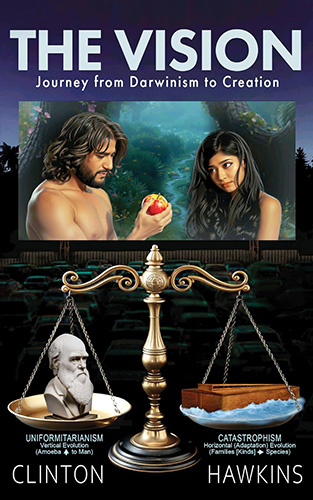
This book is in 3 parts. The first part of the book is the author’s journey from a child to his retirement as an elementary teacher and substitute teacher in 2020. This book also centers around a “Vision” the author had in High School in 1967. The “Vision” prompted the author to study both sides of the Creation/Evolution debate. Though he was not overtly aware the “Vision” was directing his path through life’s challenges from being a Darwinian evolutionist to a young earth Creationist. These two classifications have been documented by theses, first in 1975 when he satisfied the requirements to obtain a Master’s degree in Physical Anthropology as an evolutionist, and then his Creation conclusions were documented in 2020 by his narrative of the evidence that persuaded him to become a young earth Creationist.
Hawkins’ treatment of territoriality, gleaned from his first thesis provides the missing piece on how animals actually form new species from the original families, as an ecological adaptation. The author will more than buttress your faith in the Bible’s “after its kind” rendition of creation and how “horizontal speciation” is the only means whereby creation’s diversity thrives. More so, his take on “catastrophism versus universalism” is as resourceful as his original thesis on territoriality and dominance behaviors as the selective force for speciation. He explores Catastrophism as the geological concept that supports Noah’s flood and laid the ground work for a young earth with fossils being trapped by the flood waters. As an evolutionist he studied Universalism as the geological concept that life has evolved over eons of time with fossils forming from simple to complex. The author coined the terms “horizontal evolution” for the former, and “vertical evolution” for the latter so the reader can better understand these competing hypothesizes, and he concludes that deep time is not a biological mechanism. Deep time by itself will not cause change.The reader will discover the intellect of this Anthropologist is complex but exceedingly transparent in the search for truth. No, this is not an ordinary read—for Anthropologists it is simply compelling. For teachers who have worked in the public school system during the 80’s through 2010, as Hawkins did for 32 years, this is a pedagogical marvel. Likewise, one will get an amazing view of the “hippie era/lifestyle” and how a generation was affected by the “sex, drugs, and rock and roll” culture. So, this is just as much a study in American historical sociology, as it is a truly anthropological phenomenon contrasting Darwinian’s vertical evolution with Creationism’s horizontal speciation. This is the outcome of THE VISION and how it inspired him to study both sides of the debate, and that faith in Creation is the most logical conclusion. Wow, that’s a mouthful—you won’t want to put this book down. It’s not only a reference text but a revelation. You’ll understand that last sentence as you delve into THE VISION.
Hawkins’ treatment of territoriality, gleaned from his first thesis provides the missing piece on how animals actually form new species from the original families, as an ecological adaptation. The author will more than buttress your faith in the Bible’s “after its kind” rendition of creation and how “horizontal speciation” is the only means whereby creation’s diversity thrives. More so, his take on “catastrophism versus universalism” is as resourceful as his original thesis on territoriality and dominance behaviors as the selective force for speciation. He explores Catastrophism as the geological concept that supports Noah’s flood and laid the ground work for a young earth with fossils being trapped by the flood waters. As an evolutionist he studied Universalism as the geological concept that life has evolved over eons of time with fossils forming from simple to complex. The author coined the terms “horizontal evolution” for the former, and “vertical evolution” for the latter so the reader can better understand these competing hypothesizes, and he concludes that deep time is not a biological mechanism. Deep time by itself will not cause change.The reader will discover the intellect of this Anthropologist is complex but exceedingly transparent in the search for truth. No, this is not an ordinary read—for Anthropologists it is simply compelling. For teachers who have worked in the public school system during the 80’s through 2010, as Hawkins did for 32 years, this is a pedagogical marvel. Likewise, one will get an amazing view of the “hippie era/lifestyle” and how a generation was affected by the “sex, drugs, and rock and roll” culture. So, this is just as much a study in American historical sociology, as it is a truly anthropological phenomenon contrasting Darwinian’s vertical evolution with Creationism’s horizontal speciation. This is the outcome of THE VISION and how it inspired him to study both sides of the debate, and that faith in Creation is the most logical conclusion. Wow, that’s a mouthful—you won’t want to put this book down. It’s not only a reference text but a revelation. You’ll understand that last sentence as you delve into THE VISION.